
Dakota County Arrest Reports
Dakota County posts no rolling 72-hour, seven-day, or weekly booking blotter. The official gap forces a workaround. The county's Jail Inmate Search covers only people in custody at that moment. It works well for a present status check. Once someone posts bail, gets a release order, or transfers, the roster entry disappears, so the tool cannot rebuild several days of arrests.
The Criminal Complaint Search offers the wider official window. Complaints stay searchable for twelve months, with exclusions. A complaint starts a court case and lists the alleged facts and charges, though it may not cover every booking in the county.
Read Dakota Arrest Records Chronologically
Start at custody and move toward the permanent record. Each date means something different. A date may mark the arrest, the jail posting, the complaint filing, or a court setting, so keep each source label separate rather than merging one timeline.
- Check the current jail roster for a person still held.
- Search the county complaint portal for a filed case within its stated 12-month span.
- Use Minnesota Court Records Online or court administration for case events and disposition.
- Request the booking or permanent jail record from the Sheriff when the online window fails.
- For much older material, ask whether the record remains with the county or moved under an approved retention schedule.
Use Arrested Today instead. That search confirms a fresh intake, not a several-day chronology of Dakota County arrests.
Dakota Arrest Report Fields
No unified log entry exists. Each official source decides which arrest fields appear, so the roster's search form should not be mistaken for a full booking card.
| Source item | Meaning and limit |
|---|---|
| Name | Current roster name; identity may require fingerprint confirmation. |
| Date posted | Roster filter label, not a defined arrest timestamp. |
| Court date | An estimated schedule for a current detainee. |
| Alleged charges | Complaint or court information that can change. |
| Booking photo | Generally public under Minnesota law, but not promised in the roster interface. |
| Disposition | The court’s result, which is not a booking field. |
Dakota County's custody records hold broader intake data. Medical, safety, identity, juvenile, sealed, and investigative details may be restricted, so a requester should name the precise public record sought.
Weekend Dakota Arrest Reporting
No county source follows a weekend or holiday update schedule. Intake happens at any hour. Filing and court events run on their own clocks. A Monday search can surface a case the same route hid all weekend. That is timing, not concealment.
Run the roster search again first. When custody must be confirmed, call Dakota County Jail information at 651-438-4800. For documents, use the Sheriff's data-request form, and check any roster court time with District Court Administration since those times are only estimates.
Dakota Jail Record Archives
Minnesota Statutes § 641.05 makes the sheriff keep a permanent record of everyone committed to jail. That record is broader than a roster entry. It can hold the name, the commitment authority and date, a description, and the release authority and date. Not every booking photo stays online forever.
Start with the Sheriff Transparency page. Ask for the booking record, the photograph if relevant, the date range, and the retention schedule. The Minnesota Government Data Practices Act governs access. Inspecting public data is free. Copies may carry allowed charges, though the county posts no fixed booking-photo fee or guaranteed turnaround.
Dakota Police Blotters Are Selective
The Star Tribune's historical Dakota County police blotter grouped selected reports by city and date. It admitted it was never comprehensive. Sheriff and County Attorney releases also pick featured cases rather than every arrest.
A historical Burnsville Patch report marks the same era. These are news artifacts, not county services.
Its age makes it context only. It proves nothing about current custody or warrant status.
Unofficial Dakota Arrest Archives
After official sources, third-party pages offer leads. RecentlyBooked pushes a rolling Dakota County view. Mugshots.com and Arrests.org expose older county pages, but none of these sites is the county's arrest log. Entries can be copied, delayed, mislabeled, incomplete, or left standing after the official status changes. Busted Newspaper and Mugshots.zone carry no Dakota County section.
The unofficial RecentlyBooked Dakota County page is one such archive.
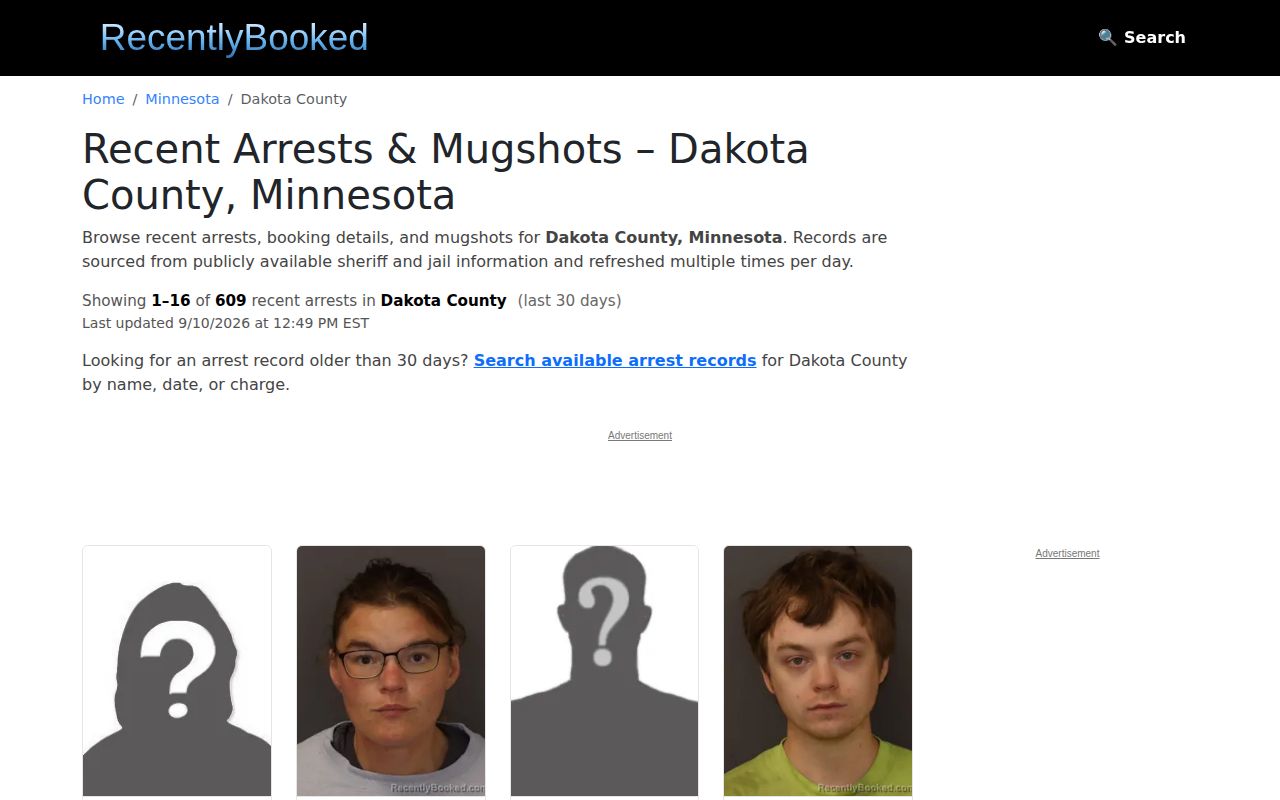
Confirm any lead with the Sheriff, jail, complaint portal, or court. The unofficial Arrests.org Dakota page is another archive.
Its filters do not make it official or complete.
Dakota Charges Require Disposition
An arrest or complaint only starts a case. Charges can be amended or dropped later. Some cases end in diversion, and some defendants are acquitted at trial. Court records hold the rest of the story.
MCRO has one big limit. A pending criminal case may not show in a defendant-name search until a conviction as defined by law appears. Try a case number, citation, attorney search, courthouse terminal, or direct court inquiry instead. A blank name result does not erase a real booking, and an old article never proves the final outcome.
Request Older Dakota Arrest Records
Vague requests slow everything down. Ask for one thing, not five. Include the person's full name and a rough booking date. Also name the record type you want: the public booking record, the commitment and release entries, or a booking photograph. Dakota County's data-practices materials walk you through inspection and copies. They stop short, though. No single fee or response time is promised for every jail item.
A permanent jail record and a booking photo are different animals. Minnesota's permanent-record statute keeps commitment and liberation documentation alive. Whether a particular image survives is another question. Record schedules settle it, along with classification rules, expungement orders, and agency systems. When the Sheriff no longer holds an old record, try county records management. You can also ask the Minnesota State Archives. Find out whether jail registers transferred under an approved schedule.
Old newspapers can fill in context once the official search ends. The Minnesota Historical Society has a listing. It names the Dakota County Tribune as a weekly with a long archive. The Dakota County Historical Society, meanwhile, helps researchers with print, microfilm, and local materials. Neither acts as a current booking authority. A newspaper date may reflect publication rather than arrest. An archived report still calls for a court disposition check.